
How to Check Criminal History in Waterloo
Start where the record was made. Waterloo Police holds its own incident and arrest reports. Monroe County Jail can confirm current custody, while the Monroe County Circuit Clerk holds filed charges, hearings, orders, and dispositions. ISP provides statewide conviction information and a fingerprint-based Access and Review process for a person checking their own record.
- Identify whether the event began with Waterloo Police or another agency.
- Request the specific WPD incident or arrest report through the city FOIA channel.
- Call Monroe County Jail when current booking or custody is the question.
- Search the Monroe Judici endpoint, then contact the clerk if the portal fails.
- Use ISP conviction information or Access and Review only when that broader state layer is needed.
A Waterloo police report does not prove charges were filed. A booking does not prove guilt. Read the final disposition for each count in the court record.
Waterloo Police Records Counter
The Waterloo Police Department is at 301 S. Main Street and answers at 618-939-3377. Chief Dane Luke leads a department described by the city as 15 full-time officers, including command, detective, sergeant, and patrol roles, plus five crossing guards. That local structure matters because WPD, not Monroe County government, remains custodian of a WPD-created narrative.
Waterloo Police Department
301 S. Main St.
Waterloo, IL 62298
618-939-3377
Monroe Circuit Clerk
100 S. Main St., Room 115
Waterloo, IL 62298
618-939-8681
The official WPD page shown here gives the police building, department contacts, staffing, and programs.
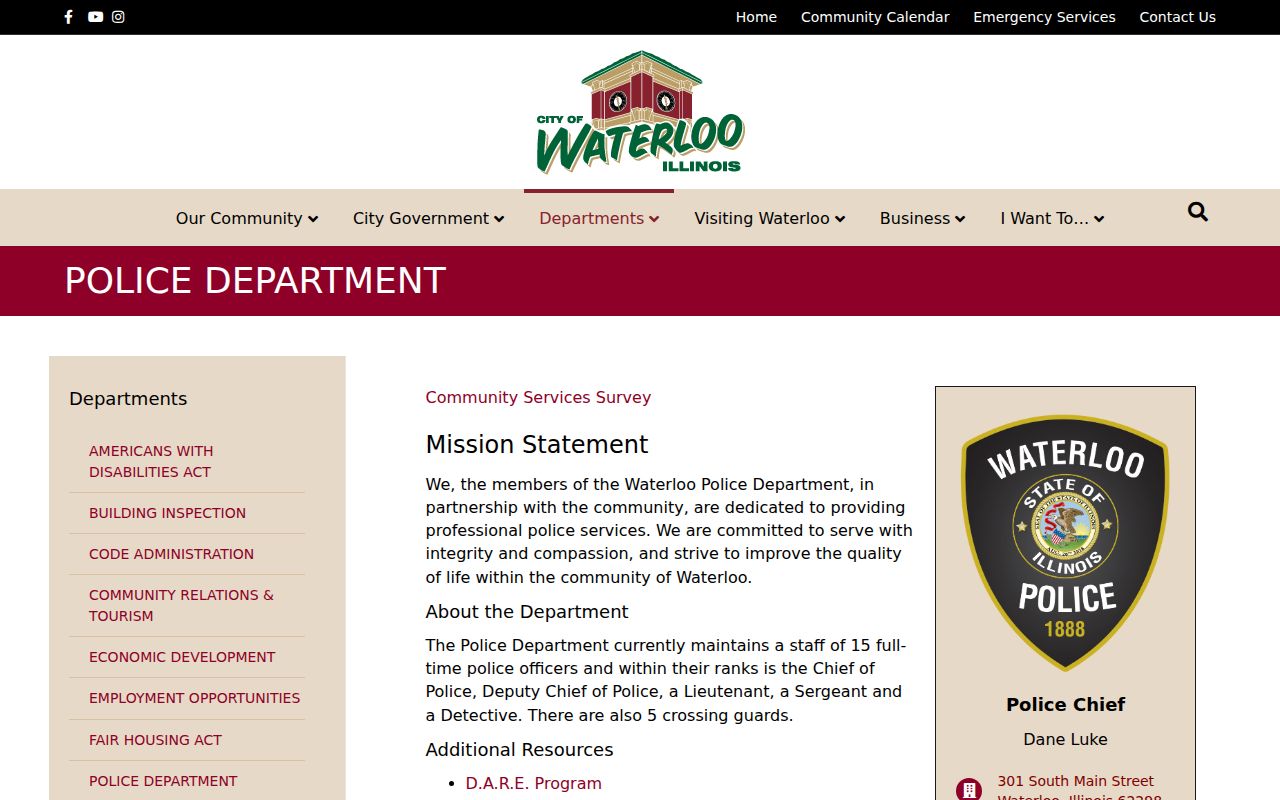
Use that police address for report requests, not the separate City Hall counter.
The Waterloo Police Department
WPD records can include incident narratives, arrest reports, and related administrative material. Release depends on Illinois FOIA exemptions and the state rules protecting victims, minors, medical facts, confidential sources, security details, and active investigations. Ask for the nonexempt part if some content must be withheld.
A strong request states the event date, approximate time, exact or near location, involved person’s name, incident or report number if known, and the precise item sought. “All records about a person” is harder to search and may draw a clarification request. Specify whether delivery should be pickup, mail, email, fax, or inspection.
Waterloo FOIA Form Anatomy
The Waterloo Police FOIA form asks for the requester’s name, date, address, signature, email, telephone, a specific description, and whether the request has a commercial use. It offers pickup, mail, email, fax, or inspection at a mutually agreed time and place. Postage can apply to mail.
| Identity and contact | Name, address, email, telephone, signature, and date. |
|---|---|
| Record description | Describe the event and exact report component sought. |
| Purpose field | Mark commercial use accurately. |
| Delivery | Pickup, mail, email, fax, or agreed inspection. |
| Office tracking | Received date, response due, fee, FOIA number, completion details. |
The back-office fields explain why a requester may later see a tracking number or fee explanation. Keep a copy of the submitted form and note the delivery date.
Waterloo Police Copy Fees
Waterloo’s form makes the first 50 black-and-white letter or legal pages free. Additional pages cost $0.15 each. The form also lists 8.5-by-11-inch color pages at $0.15 each. Mail can add postage. An electronic record may avoid paper-copy charges when the file already exists in that form.
| Item | Waterloo form amount |
|---|---|
| First 50 B&W letter/legal pages | No charge |
| Each additional B&W page | $0.15 |
| 8.5 x 11 color page | $0.15 |
| Mail delivery | Postage may apply |
Ask for a current quote when the request involves unusual media, certification, or a large file. Fees do not determine whether a record is public.
Arrests and Bookings in Waterloo
No official Waterloo arrest blotter or standalone WPD case portal was verified. For a Waterloo arrest, WPD holds the police report. Monroe County Jail creates the booking and custody record if the person is taken there. The jail can be reached at 618-939-8651, but no verified official browser roster exists.
Once the State’s Attorney files a case, the Circuit Clerk record becomes the best source for formal charges and outcomes. The clerk’s criminal desk is extension 237; traffic, ordinance, juvenile, and background-check routing uses extension 249. Recent events may appear at different times across police, jail, and court systems.
Local record chain: Waterloo Police › Monroe County Jail › Monroe County Circuit Court.
Waterloo Police Programs Since 1987
Waterloo’s police profile is more than a records counter. Its DARE program has operated since 1987 as a 16-week fifth-grade curriculum. The department also lists drug takeback, active-shooter training, Home Alone, Senior Academy, identity-theft training, and domestic-violence programming.
These programs do not create a public criminal-history portal. They do help identify which city office ran an event or received a report. When seeking a program-related record, name the program, date, school or venue, and the type of document rather than asking for broad police history.
Write a Searchable Waterloo Request
A useful WPD request describes an existing record instead of asking the police to research a broad question. Start with the incident date and a short time window. Add the street, intersection, business, or other location. Supply the report number when known, and identify whether the desired item is an incident narrative, arrest report, dispatch record, or another named component.
Names should be accompanied by another lawful identifier when possible. Common names can pull unrelated files, while a misspelled name can hide the right one. If the report number is unknown, say so and give the facts that let the records officer search. Choose a delivery format the department offers. Email may be fastest for an existing electronic file, but inspection can make sense for a large record set.
WPD may ask for clarification when the scope cannot be understood. A clarification is not the same as a denial. Answer it promptly and keep the original request, the response, and any FOIA number together. When a redaction appears, the response should explain its legal ground. Ask for the rest of the record if an exemption applies only to one passage or attachment.
Waterloo Municipal Court Records
Waterloo has no separate modern municipal court. Illinois’s unified judiciary routes city ordinance and traffic cases into the Monroe branch of the 24th Judicial Circuit. Searching for a “Waterloo Municipal Court” site can therefore miss the real docket.
| Court Name | Monroe County branch, 24th Judicial Circuit. |
|---|---|
| Waterloo Case Types | Ordinance, quasi-criminal, traffic, DUI, misdemeanor, and felony matters as filed. |
| Lookup Channel | Judici’s exact Monroe endpoint, clerk counter, or public terminal. |
| Docket Contents | Case number, type, charges, events, hearings, disposition, sentence, and financial entries when public. |
| Copies | Request from Circuit Clerk; ask for current copy and certification fees. |
Useful codes include OV for ordinance violation, QC for quasi-criminal, TR for minor traffic, MT for major traffic, DT for DUI, CM for misdemeanor, and CF for felony.
Police Department Versus Waterloo City Hall
Waterloo City Hall is at 100 W. Fourth Street and is open weekdays from 8 a.m. to 4 p.m. Police records go instead to WPD at 301 S. Main Street. Sending a report request to the general city counter can delay routing even though both offices serve Waterloo.
The official City Hall contact page shown here makes the separate municipal address visible.
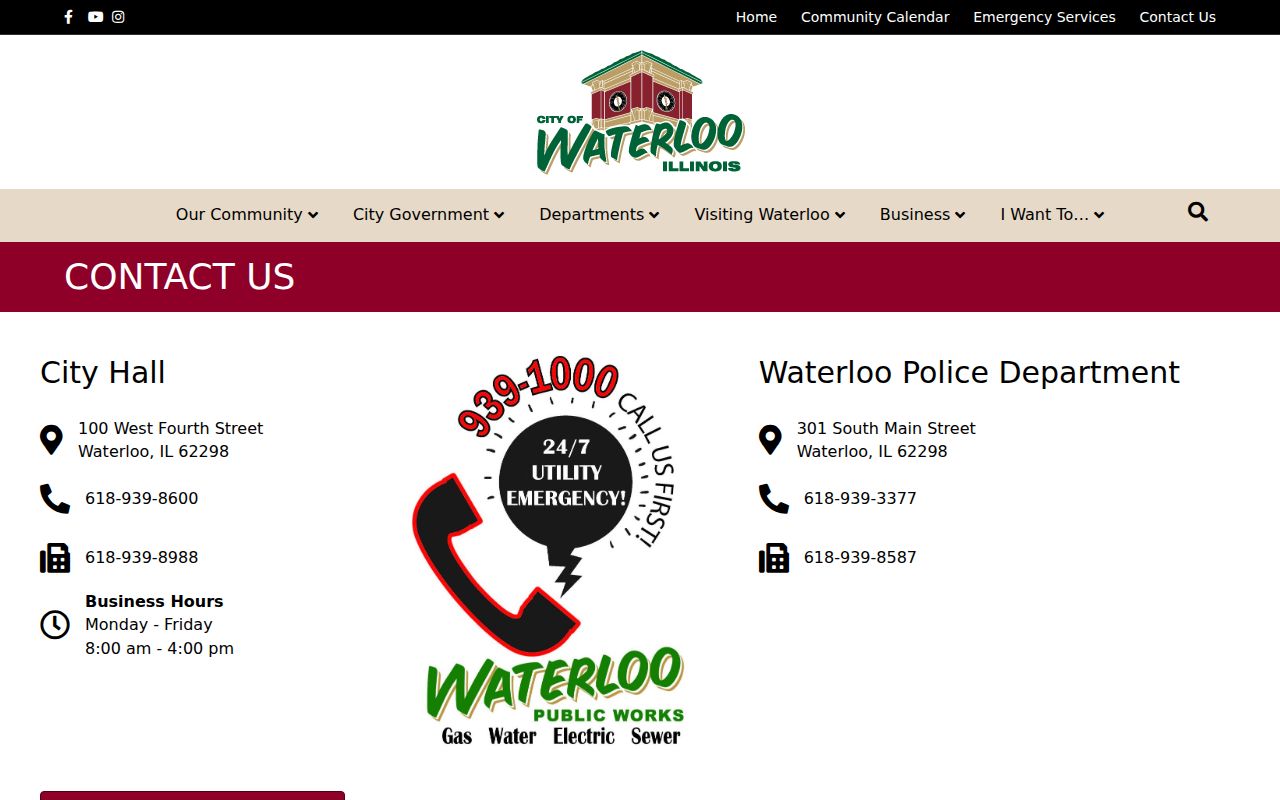
Use City Hall for general city business and the police address for WPD incident or arrest records.
Waterloo Protection-Order Record Bridge
Waterloo Police lists domestic-violence programming among its services, while the court system maintains orders of protection and related case activity. These are separate functions. A police incident report comes from WPD. A petition, order, hearing date, or judicial ruling comes from the Circuit Clerk, subject to access limits and court rules.
Someone looking for their own record should first decide whether the missing item is a police document or a court document. Use the case number when one exists. OP is the local case code for an order of protection. Protected addresses, minor information, and sensitive filings may be restricted even when a public docket entry exists. For urgent safety help, contact police or an appropriate service provider rather than relying on a docket search.
Where Waterloo Records End Up
A Waterloo event can create files in several offices. WPD keeps the source report. Jail staff keep custody data. The State’s Attorney decides which charges to file, and the Circuit Clerk maintains the resulting case. Qualifying arrest fingerprints and later dispositions flow to the Illinois State Police Bureau of Identification.
Record flow: Waterloo Police › Monroe County Courts › Illinois State Police Bureau of Identification.
The newer the event, the more important it is to check the source agency. For an older resolved matter, compare the court disposition with the state record. Reporting lag or an unmatched disposition can explain a mismatch. A person reviewing their own history can use ISP Access and Review and challenge errors through the official process.
Waterloo County-Seat Record Hub
Waterloo is both a city and the Monroe County seat. The police department, county jail, courthouse, Circuit Clerk, sheriff, State’s Attorney, and probation operations are concentrated here, but they remain separate custodians. The right Waterloo office depends on who created the record.
The clerk counter is at 100 S. Main Street, Room 115, while the sheriff and jail are at 225 E. Third Street. A court payment placed in the shared Market Street drop box should have “Circuit Clerk” written on the envelope. These address details matter because a request sent to the wrong county office is not the same as a request to WPD.
Public Access Rules
Police, jail, court, and state records should be compared by source and date. An agency report can preserve allegations that never became court charges. A court file can contain several counts with different results. ISP’s public conviction response is narrower than either one and may depend on name matching. For a self-review, fingerprint-based Access and Review is more reliable and includes a formal correction path. When records conflict, return to the office that created the disputed fact, provide the case or report number, and ask what proof is needed to correct it.
Historical Waterloo material may also fall outside modern Judici coverage. The Illinois Regional Archives Depository for Monroe County routes older research to courthouse offices and the Southern Illinois University repository. Give the person, record series, and approximate year. That archive channel supports genealogy and institutional history; it is not a current background-check service.
Executive-branch records from Waterloo Police fall under the Illinois Freedom of Information Act. Ordinary requests generally use a five-working-day response framework, subject to a lawful extension. Court records are governed by the clerk, court orders, and the judiciary’s electronic-access policy rather than ordinary city FOIA.
Key Statutes:
5 ILCS 140 sets the request, response, exemption, and copy-fee framework for Waterloo Police records.
20 ILCS 2635 governs public Illinois conviction information.
Illinois electronic court-access policy excludes sealed, expunged, impounded, and protected sensitive files from ordinary electronic view.
When an exemption covers only part of a Waterloo report, ask for the segregable, nonexempt remainder and the legal basis for each redaction.