
Criminal Cases in the Monroe County Courts
The Monroe County branch of the 24th Judicial Circuit hears felony, misdemeanor, domestic violence, DUI, traffic, conservation, and ordinance matters. Illinois circuit courts are trial courts of general jurisdiction. There is no separate Waterloo, Columbia, or Valmeyer municipal court. City ordinance and traffic cases also enter the circuit system.
The State's Attorney decides which state or county-ordinance charges to file. The Circuit Clerk then keeps the complaint, docket, filings, orders, outcome, sentence, and financial entries. That split matters. An arrest report remains with the arresting police agency, while the filed criminal case belongs at the clerk's office.
The courthouse also houses the State's Attorney and county probation. The prosecutor's office files charges, but the clerk is the public-record custodian for the case. Probation may supervise a community sentence after judgment. Its detailed supervision file is not the same thing as the public sentence recorded on the docket.
Monroe County Judici Case Search
The clerk endorses the county's exact IL067015J Judici endpoint. It is the best first stop for a modern Monroe County criminal case search. Basic entry starts free, while some document or premium functions may require an account or payment.
The captured portal shows a humanity check before the case tools. See the official Monroe search source before using the interface shown here.
The gate is a portal control, not proof that no record exists. If it fails or a document is missing, move to the clerk fallback instead of guessing from a blank result.
The clerk's daily docket is a second online clue. It helps confirm the next listed court date, but it is not a full historical index. Weekend views may advance to the next session. Compare any daily listing with the case docket, since hearings can be reset and a calendar entry does not show the result.
How to Search Case Records
Start with a case number when one is known. It avoids confusion between people with similar names and reveals the case type. Judici's post-gate fields were not copied because the humanity screen prevented an ethical sample inspection. The steps below use only functions confirmed by the official clerk and visible portal navigation.
- Open the Monroe-specific Judici endpoint and pass its humanity check.
- Search with the case number or the most exact party-name details available.
- Use the filing year and local case code to separate close matches.
- Read every count, docket event, and disposition rather than relying on the first charge shown.
- Ask the Circuit Clerk for an archived file, full document, or certified copy when online data is incomplete.
| Field Label | Type | Required | Notes |
|---|---|---|---|
| Party name | Text | Search option | Use exact spelling and verify identity with the case details. |
| Case number | Text | Search option | The strongest identifier when copied from a notice or filing. |
| Filing year | Number | Filter | Helps narrow repeat names and older matters. |
| Case type | Code | Filter | Examples include CF, CM, DV, DT, and OV. |
| Docket | Result view | After search | Read dates, events, counts, and outcomes in sequence. |
Monroe Criminal Clerk Fallback
The Monroe County Circuit Clerk provides the practical backup. The public counter is Room 115 at 100 S. Main Street, Waterloo, Illinois 62298. It is open weekdays from 8:00 a.m. to 4:30 p.m. Call 618-939-8681, extension 237 for the criminal supervisor. Extension 249 serves background-check, traffic, ordinance, and juvenile routing.
A law-library terminal is available for court research and e-filing. Ask staff about archived or nonelectronic material and current copy or certification prices. The source page also links daily dockets and payment channels. On weekends, the daily docket advances to the next court date, so it should not be read as proof that no case is pending.
Payments can be made through Judici, CourtMoney, mail, the counter, or a shared drop box in the Market Street circle drive. Mark a drop-box envelope “Circuit Clerk” because several courthouse offices use the same box. Payment is not a substitute for reading the disposition, and it does not by itself resolve an outstanding warrant or change a docket entry.
The official clerk page is shown in the successful project capture below.
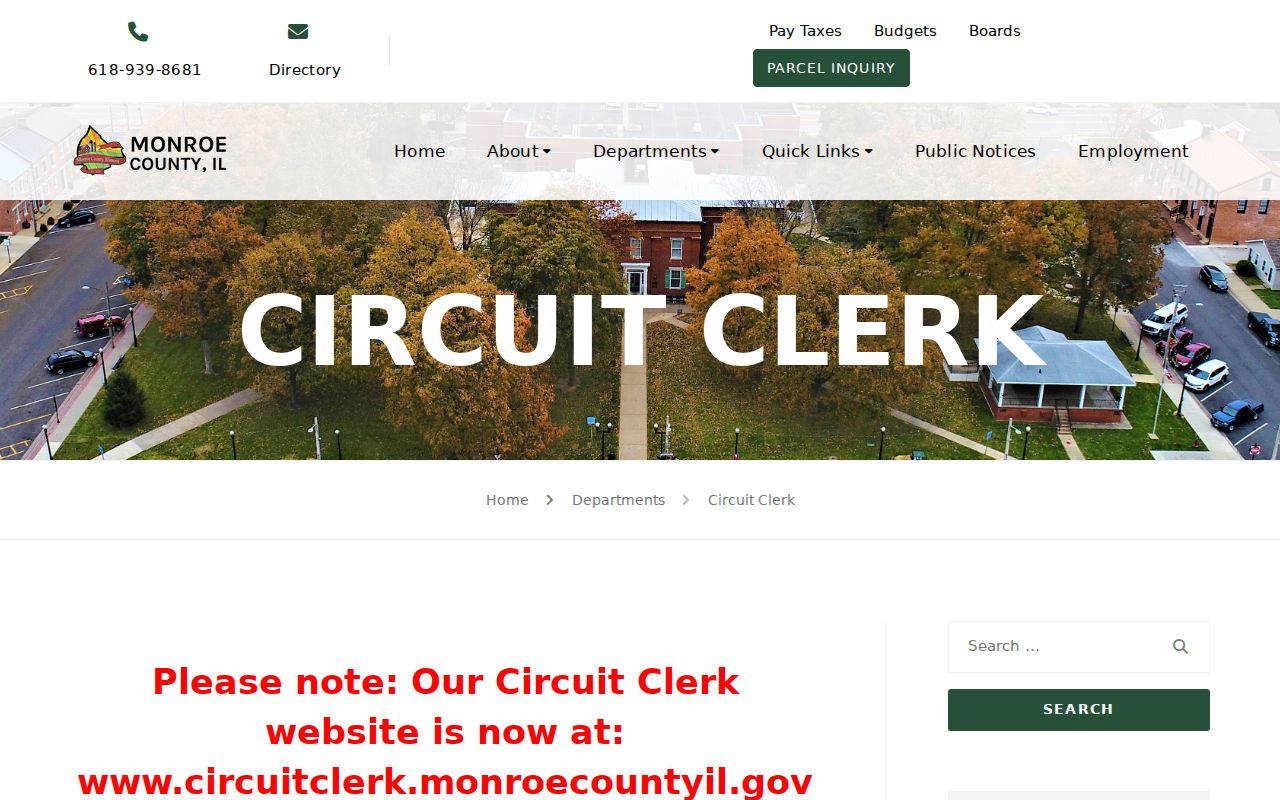
Its clerk contacts and docket links complete the search when the vendor portal does not show the needed file.
What the Case File Shows
A Monroe County criminal court file records litigation, not just an arrest. Availability varies under the Illinois electronic-access policy, and a portal summary may not include each filed document. Read the charging paper with the docket and final order so early allegations are not mistaken for the result.
| Case Number & Court | Identifies the Monroe branch, filing year, and case category. |
|---|---|
| Charging Document | The complaint, information, or indictment stating each alleged count. |
| Docket Entries | A dated list of filings, hearings, motions, and court orders. |
| Hearing Dates | Past and scheduled court events, subject to later changes. |
| Disposition & Judgment | The result for each count, such as dismissal, acquittal, supervision, or conviction. |
| Sentence & Conditions | Custody, probation, restitution, fines, and other terms when publicly available. |
Reading Monroe Criminal Case Codes
Local codes help route a search. They do not state guilt or severity by themselves. CF means Criminal Felony, CM Criminal Misdemeanor, DV Domestic Violence, MX Miscellaneous Criminal, and DT DUI. Traffic and local matters may use TR, MT, OV, or QC.
- Pending
- The count or case has not reached a final outcome.
- Disposed
- The court has resolved it, though later review may still occur.
- Nolle prosequi
- The prosecutor has declined to continue that charge.
- Supervision
- An Illinois nonconviction outcome if its terms are completed successfully.
- Vacated
- A prior judgment or order has been set aside.
One docket may combine convicted and dismissed counts. Always match the term to its specific count and date.
Other local codes matter too. CC marks contempt, CV conservation violations, and OP orders of protection. Juvenile categories include JV, JA, and JD, which have stronger access limits than adult cases. A code guides the search and the clerk desk that can help. It should never be used alone to label a person's conduct.
Stages of a Criminal Case
A police report or arrest may reach the State's Attorney, but the court case starts when charges are filed. A first appearance addresses initial process and pretrial release or detention. An information may be filed by the prosecutor, while an indictment is a grand jury's accusation. Arraignment is the stage when the charge is addressed and a plea is taken.
Discovery and motions follow. The matter may end through dismissal, a plea, or trial. Judgment and sentence come after a finding of guilt, with appeal or postjudgment proceedings possible later.
Case flow: Charges Filed › Arraignment › Pretrial › Plea or Trial › Disposition › Sentencing
Monroe Circuit Court Structure
The Illinois Courts directory places Monroe in District 5, Circuit 24. General courthouse hours there are 8:30 a.m. to 4:30 p.m., while the clerk publishes an 8:00 a.m. counter opening. Both may be correct because they describe different operations.
The official 24th Circuit Monroe page lists the judges and courthouse offices.
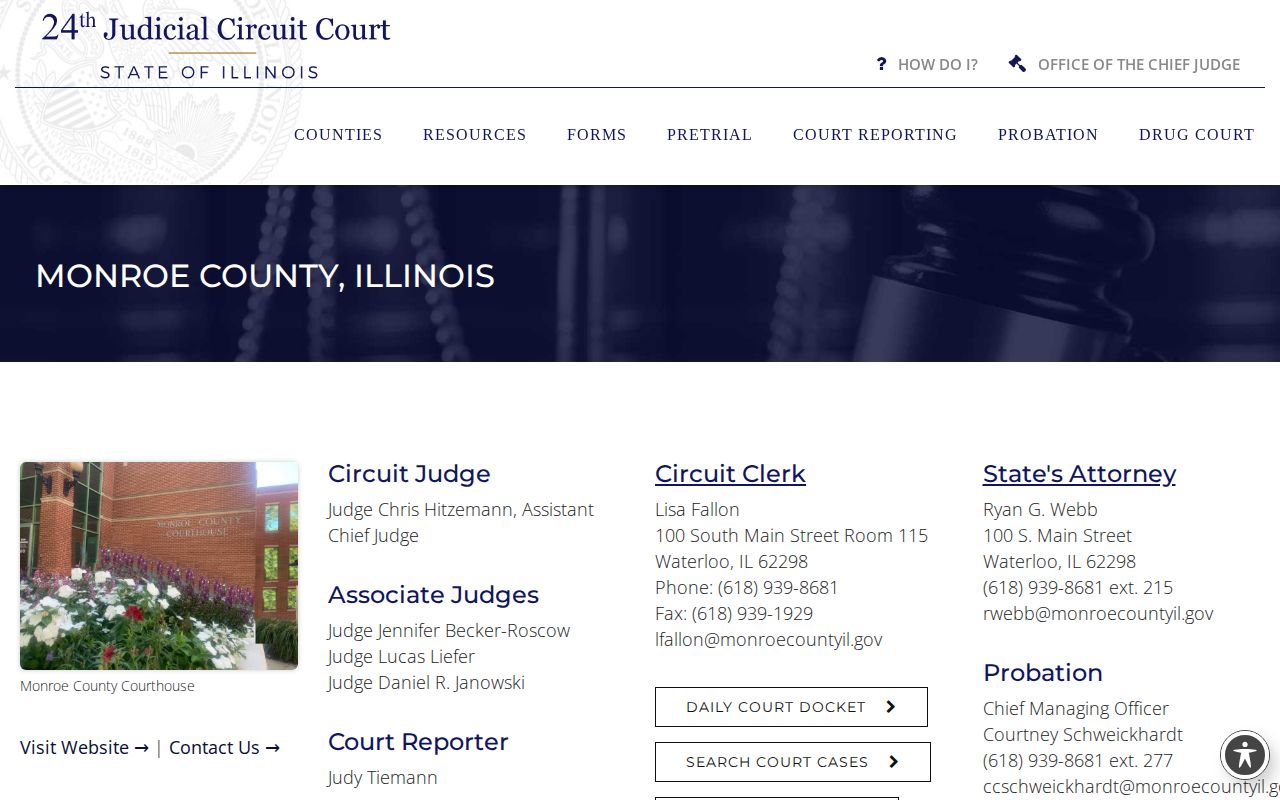
This unified structure explains why a search for a stand-alone city court misses present ordinance, quasi-criminal, and traffic cases held in the circuit file.
Access & Restrictions
The Illinois electronic public-access policy does not expand the public's legal right of access. Sealed, expunged, impounded, juvenile, and other protected material stays outside ordinary electronic view. Sensitive identifiers can also be withheld even when the rest of a file is public.
A missing online result may reflect a spelling issue, an older paper file, restricted access, or a record that never became a court case. Contact the clerk for the proper access route. Court files come from the judicial clerk, not from a routine county FOIA request. For one's own eligible matter, use the current Illinois expungement and sealing forms, not an old saved packet.
Expungement generally removes the public index and destroys or returns records as the statute directs. Sealing restricts ordinary public access but preserves access for bodies authorized by law. Neither occurs merely because a count was dismissed. A petition must be filed in each circuit jurisdiction involved, and eligibility depends on the outcome, offense, and history.
Electronic access can also be narrower than counter access without making a protected file public. Full documents may require a clerk request or a vendor feature. Ask for the exact item needed, such as a charging paper, final judgment, sentence order, or certified disposition. This keeps the request focused and helps staff distinguish the filed document from a portal summary.
Monroe Federal Case Records
Federal prosecutions tied to Monroe County do not appear in Judici. The Southern District of Illinois serves the area from East St. Louis, and PACER supplies federal dockets and documents. PACER is separate from the county circuit system.
The federal court's official location page is the source for the successful capture below.
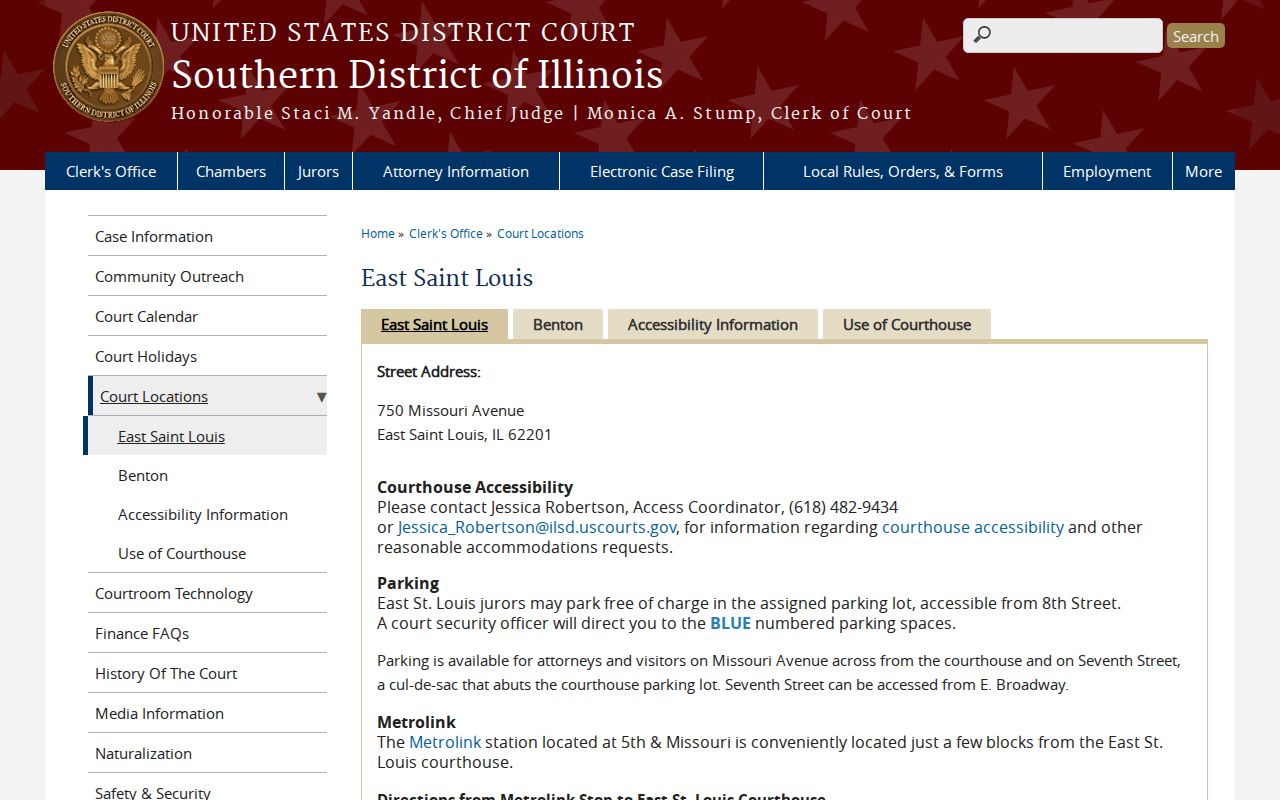
Use this route only for federal cases. State felony, misdemeanor, DUI, and ordinance files remain with Monroe County Circuit Court.