
Arrest History in Monroe County
The local arresting network includes the Monroe County Sheriff, Waterloo Police, Columbia Police, Valmeyer Police, Illinois State Police, and Illinois Department of Natural Resources Conservation Police. Sheriff patrol serves the unincorporated county and towns without round-the-clock police coverage. The agency making the arrest keeps its incident and arrest report, even when the person is booked at the county jail.
An arrest history is not one file. It can include an agency report, jail intake record, court docket, and state fingerprint cycle. Each answers a different question. The report documents the event, booking documents custody, and a later court file shows whether charges were filed and how each count ended.
The sheriff patrol page describes 12 full-time deputies, with two sergeants across four shifts, serving a rounded 398-square-mile area. Their duties include calls, reports, DUI and drug enforcement, warrants, and civil process. Those facts explain the sheriff's role but do not turn its press releases into a full arrest index.
No Monroe County Jail Roster
No verified official browser-based Monroe County inmate roster or complete booking log was found. The honest first step for current custody is to call the jail at 618-939-8651. For an existing booking sheet or arrest report, use the records or FOIA route. A name absent from press releases or app alerts proves nothing because those channels are selective.
Note: Current custody is only one point in time and cannot establish a person's full arrest history.
A current-custody answer may change after release, transfer, or a court decision. Record the time of the call and ask which office can confirm a booking identifier or release status. For historical research, use a written records request instead of expecting jail staff to reconstruct years of events by phone.
How to Look Up Monroe County Arrests
Use a channel-complete search because Monroe County has no single arrest database. Gather the full name, approximate event date, location, arresting agency, and incident or case number when known. Keep the report request separate from a custody call and from a court search.
- Call Monroe County Jail at 618-939-8651 to ask about present custody.
- Contact the arresting agency for its incident or arrest report. City police reports remain with that city.
- Search the Monroe Judici court endpoint after charges may have been filed.
- Use Illinois State Police UCIA for public statewide conviction information, or Access and Review for one's own fuller record.
- Submit a precise Monroe County FOIA request for an existing releasable sheriff or jail record.
Who Holds Monroe Arrest Reports
Record ownership follows creation. Waterloo, Columbia, and Valmeyer police keep reports made by their officers. The sheriff keeps its own reports and jail-created custody material. ISP and Conservation Police hold the records they create. Booking at Monroe County Jail does not transfer a city police narrative to the sheriff.
That distinction controls the quickest request. Ask city police for its officer's narrative, the jail for intake or release material, and the Circuit Clerk for the complaint and disposition. If several offices took part, identify each record sought instead of sending one broad request everywhere.
Monroe County Sheriff and Jail
225 E. Third St.
Waterloo, IL 62298
618-939-8651
County FOIA Officer
100 S. Main St.
Waterloo, IL 62298
618-939-8681 ext. 232
foia@monroecountyil.gov
Ask for the component that exists, such as an incident narrative, arrest report, booking sheet, CAD log, 911 audio, or photograph. A request for an agency to answer a broad question is not a request for an existing record.
Waterloo Police routes its records through the city's police FOIA channel. Columbia Police likewise names its own FOIA officers and police address. Valmeyer uses its village FOIA process, including a special stated timeline for arrest and criminal-history chronological requests. These local routes remain distinct from the county jail and court channels.
What an Arrest Record Shows
No private Monroe County booking sample was inspected, so the fields below are record categories supported by the research, not claims about a public roster layout. The agency report and jail booking should be requested separately because they may contain different identifiers and times.
| Booking Identifier | Links jail intake and custody activity to the booked person. |
|---|---|
| Booking Date & Time | Records when jail intake occurred, which can differ from the encounter time. |
| Arresting Agency | Identifies which office holds the underlying arrest report. |
| Charges | Lists allegations at intake; later filed court charges can differ. |
| Release Information | May show whether custody ended or moved elsewhere. |
| Booking Photograph | Release depends on FOIA, exemptions, redaction, and the agency's responsive record. |
| Court Link | A case number, when filed, connects the booking trail to the docket and disposition. |
Inside Monroe County Jail Records
The jail at 225 E. Third Street was built in 1986. The 2024 IDOC inspection gives it a rated capacity of 42, with 38 male and four female spaces. Its inspection-day population was 34. Eight full-time and five part-time jail staff were reported.
Jail records can extend beyond booking to property, custody, screening, visits, mail, and release. Some details are protected. Juvenile jail records are not open to ordinary public inspection without proper authority. Medical and mental-health material also receives privacy protection.
The inspection found 2,057 of 2,175 expected 30-minute observation checks timely, or 95 percent, and cited the shortfall. That operational finding describes jail compliance. It is not part of any person's arrest record.
Fingerprints for qualifying felony and Class A or B misdemeanor arrests feed the Illinois State Police Bureau of Identification. The final court outcome should later link to that arrest cycle. Delay, a spelling variation, or a disposition that did not link correctly can cause records to disagree. A person checking their own history can use ISP Access and Review, then compare it with the Monroe agency report and court file.
Recent Arrests and Booking Logs
The sheriff's press releases and official mobile app may provide selected alerts, news, tips, public-safety database links, and jail information. They are communications tools, not a complete Monroe County arrest log. The official wording does not establish an app-only warrant or arrest database. Never infer a clean record from silence there.
For a recent event, call the jail for custody, contact the originating agency for its report, and search Judici after filing. A fresh arrest may not yet have a court case. Conversely, a person released from jail may no longer appear in a custody check even though the agency and court records remain.
Note: Press releases are selective, and no verified official public Monroe County booking roster exists.
The record flow also creates delay. An officer first prepares incident and arrest paperwork. Jail staff create intake and custody records if booking occurs. The State's Attorney then reviews the matter, and filed charges may differ from booking allegations. Only after filing does the Circuit Clerk open a searchable court case and add later hearings and outcomes.
Request Monroe Arrest Records by FOIA
The county FOIA office accepts requests in person, by mail, or by email. Provide the requester name, phone, mailing address, and email. Describe the arresting agency, approximate date, time, place, incident number if known, and each specific record component sought.
Ordinary noncommercial requests receive a response within five working days under the Illinois Freedom of Information Act. A written five-working-day extension may apply for reasons set by law. The first 50 black-and-white letter or legal pages are free, with later pages at $0.15 each. Color and oversize copies may cost the actual reproduction expense.
The county page supplies the formal fallback when no public arrest portal exists. Ask for a redacted releasable copy if part of the report is exempt.
FOIA does not override every confidentiality rule. Active investigative material, protected victim or witness details, juvenile information, medical data, and security records may be withheld or redacted. A denial should state its legal basis and review route. Narrow wording often makes it easier for the office to release the nonexempt remainder.
When Monroe Custody Transfers
A jail call covers local custody only. After a sentence and transfer to state prison, use the IDOC Individual in Custody Search. Federal custody instead belongs in the Federal Bureau of Prisons locator. Neither locator replaces the arresting agency's original report or the Monroe court disposition.
The official IDOC locator is shown below from its state source page.
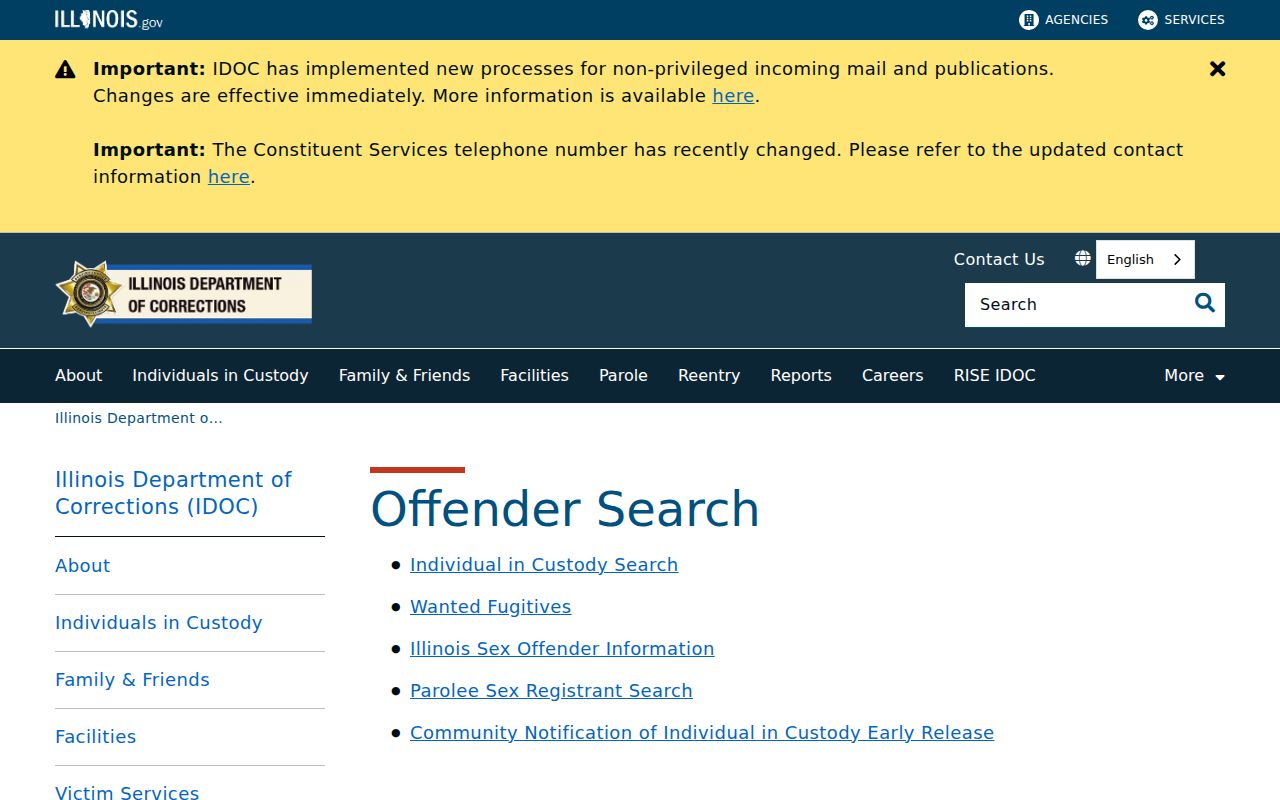
Use it only after state transfer is plausible. A no-result response does not rule out Monroe jail custody, release, another state, or federal detention.
Arrests vs Convictions
An arrest is a legal seizure based on an allegation. Booking is a custody event. A charge is an allegation filed or pursued in court. A conviction is an adjudicated outcome. These stages are held by different offices and can diverge, so the final court disposition must be checked before drawing a conclusion.
| Arrest Record | Conviction Record |
|---|---|
| Created by the arresting agency and jail | Entered by the Circuit Clerk after court action |
| Shows that an arrest or booking occurred | Shows a finding of guilt on a specific count |
| Lives with police, sheriff, or jail records | Lives in the court file and reported state conviction system |
| May be followed by release, no charge, or dismissal | May be followed by sentence, appeal, sealing, or other relief |
Note: An arrest is not proof of guilt, and a booking can end without a filed or sustained charge.
A dismissal does not automatically erase the agency or booking record. For one's own history, compare the final Monroe court disposition with ISP Access and Review. Illinois expungement and sealing may offer relief for eligible matters, but the result depends on the charge, outcome, waiting rules, and prior history. Filing a petition does not guarantee relief.