
Running a Monroe County Sex Offender Check
The Illinois State Police Sex Offender Registry is the main public source for Monroe County sex offender records. ISP updates it daily. A search can combine a name with date of birth, city, ZIP, county, status, homeless status, or offender type. Start with only the details known with confidence. Add place or birth information if a common name returns too many profiles.
A result should be treated as a registry entry, not a complete criminal history. The public file reflects registration-triggering law and the facts supplied through responsible agencies. It does not contain every arrest or court event. For the underlying case, use the Monroe County Circuit Clerk or the Monroe Judici case search. If no registry result appears but there is a sound reason to expect one, ISP directs users to local law enforcement.
Monroe County Registration Offices
Where a person lives controls the local registration stop. A resident inside Waterloo generally registers with Waterloo Police at 301 S. Main Street, 618-939-3377. Columbia residents use Columbia Police at 1020 N. Main Street. Valmeyer residents use village police through Village Hall at 260 Knobloch Boulevard, 618-935-2131. People in unincorporated Monroe County register with the Sheriff at 225 E. Third Street, 618-939-8651.
Monroe County Sheriff
225 E. Third St.
Waterloo, IL 62298
618-939-8651
Waterloo Police
301 S. Main St.
Waterloo, IL 62298
618-939-3377
Published sources do not give appointment hours for these registration tasks. Call first. The registering agency takes positive identification and proof of residence, updates the active record after successful registration, and handles many questions about compliance or accuracy.
Searching the Illinois State Police Sex Offender Registry
The ISP search begins with a disclaimer and terms of use. Search broadly before applying several filters. A miss can result from a spelling variation, a move still being processed, or a search that is too narrow.
- Open the ISP registry and accept its conditions of use.
- Enter first and last name, or begin with city, ZIP, or Monroe County.
- Narrow the list with date of birth, status, homeless, or offender-type fields when needed.
- Select “Details,” then compare aliases, physical description, address, photo dates, and agency information.
| Field | Type | Required | Use |
|---|---|---|---|
| First and Last Name | Text | No | ISP recommends this starting point |
| Date of Birth | Date/text | No | Helps separate similar names |
| City or ZIP | Text | No | Narrows the place |
| County | Dropdown | No | Includes Monroe, incarcerated, or out-of-state groupings |
| Status or Type | Dropdown | No | Filters registry category or compliance status |
| Homeless | Checkbox | No | Filters records coded homeless |
The official ISP search screen shown here illustrates the public starting point.
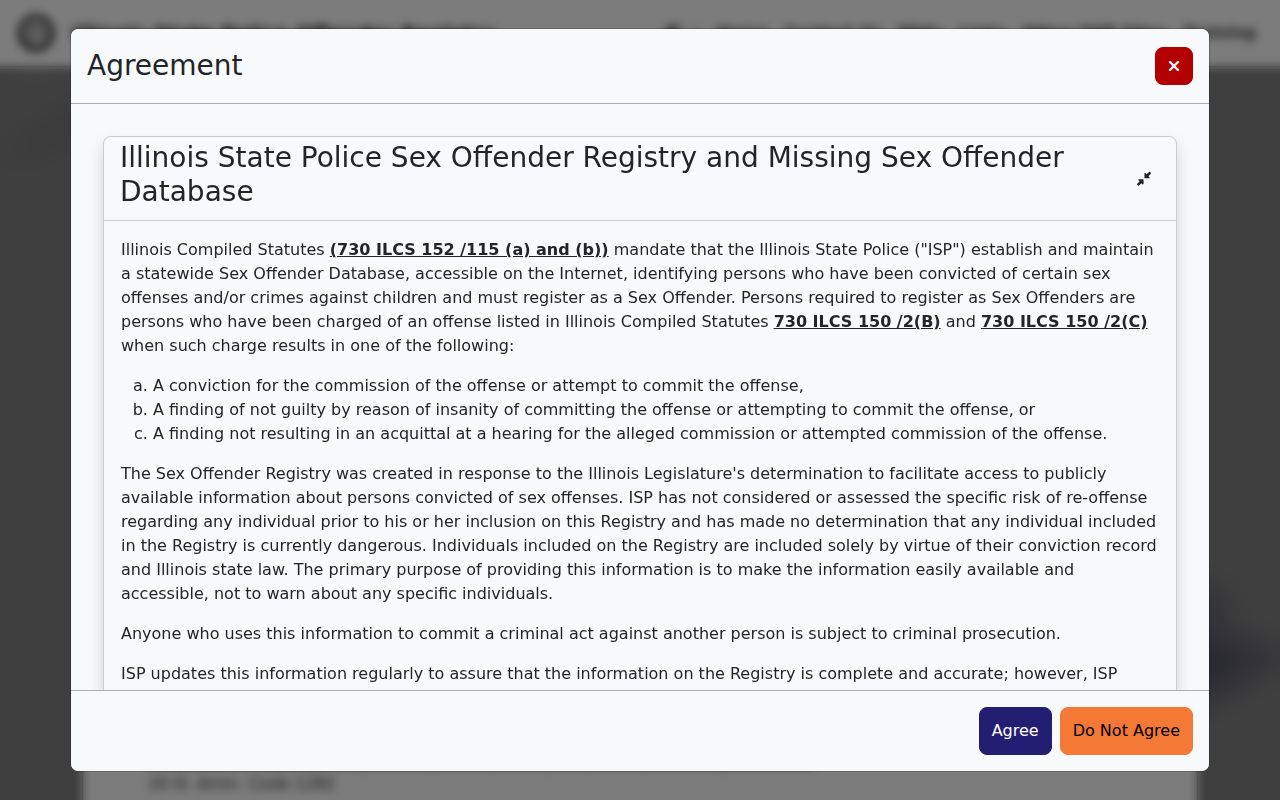
Its name and location choices make it useful for both a known-person check and a Monroe County area search.
Map Monroe County Registry Locations
ISP’s “Map Your Neighborhood” feature takes an address or a point selected on the map. Yellow markers feed a details pane. Use the map to understand registered locations around a place, but do not assume an unmarked home is risk-free. The registry is limited to people and duties covered by law, and ISP warns that compliance status does not predict future acts.
Location information deserves care. Some profiles use an institutional or homeless designation rather than a normal street address. A marker also does not establish that every person at an address is registered. Open the profile and verify the person, registering agency, and “as of” date instead of drawing a conclusion from the map alone.
What a Registry Profile Shows
A public profile supplies several identity checks and registration facts. Read them together. An alias or older photo may explain why a name-only result first appears uncertain.
| Name and Aliases | Current name, reported aliases, and alias birth dates where present. |
|---|---|
| Photo and Description | Current photo, photo-history dates, height, weight, sex, and race. |
| Registered Location | Address or institutional/homeless designation and registering agency. |
| Offense Information | Crime description, conviction county, victim and offender age fields where displayed. |
| Duration | Ten-year or lifetime registration, rather than a public federal tier label. |
| Status | Compliant or noncompliant status, recent registration dates, and an explanation when supplied. |
For a registration-form copy, contact the registering police department or sheriff. Conviction documents belong with the Circuit Clerk or State’s Attorney, while the involved agency holds the incident report. One profile cannot substitute for those distinct records.
Monroe County Changes and Verification
Registration is not a one-time filing. Illinois generally requires a covered person to report required changes within three days. Depending on the statutory category, in-person verification occurs each year or every 90 days. Reconfinement can pause or extend the running registration period, and a registration-violation conviction can add ten years measured from the next registration.
The local agency is the practical source for a current compliance question. A public status label reflects the agency’s record at a point in time. It does not decide whether a new event is a crime, and it does not forecast conduct. Give the registering office the profile identifier and the specific discrepancy. For immediate danger, use emergency services instead of a database report form.
Monroe Registry Photos and Aliases
Photo-history dates and aliases help prevent a false match. Compare the listed birth date, physical description, current or reported location, and conviction county. A shared name by itself is weak evidence. The profile’s “as of” date also matters because a daily database can still depend on agency updates and recent registration activity.
If an entry seems to describe the wrong person or shows stale information, do not try to correct it through a public comment or confrontation. Contact the registering agency shown in the profile. That office can review its registration record and route an ISP database issue. Court-file errors should instead go to the Monroe County Circuit Clerk or the court that entered the judgment.
Registration Requirements and Levels in Illinois
Illinois does not present its public registry primarily as federal Tier I, II, and III. State law uses offense and status rules that generally produce a ten-year or natural-life term. Registration usually occurs within three days of sentencing or release. Address and other required changes are also due within three days. The annual registration fee is $100, with a waiver available for indigency.
| Illinois category | Duration | Verification |
|---|---|---|
| Ordinary qualifying sex offender | Generally 10 years | In person annually |
| Sexual predator | Natural life | Annual registration |
| Sexually dangerous or violent person | Natural life | Every 90 days |
| SORA violation conviction on or after July 1, 2005 | Remaining term, subject to extension | Every 90 days |
| Repeat or specified lifetime category | Natural life | As state law requires |
The ISP registration FAQ shown here explains duration, reporting frequency, and fees.
That official FAQ is the better source for current duties than a federal tier chart that Illinois does not use as its main public display.
Monroe County 500-Foot Rule
720 ILCS 5/11-9.3 places certain location limits on specified child sex offenders. Covered restrictions can include knowingly residing within 500 feet of a school, playground, day-care or child-care site, youth-only facility, or a victim under 21. Measurement runs from property edge to property edge, and property-date clauses can affect application.
The rule should not be applied to every person on the registry. It targets defined child sex offender categories and also addresses presence or loitering at schools and public parks. Questions about a particular Monroe County address belong with the registering agency and qualified legal counsel, not a map estimate.
Note: A registry marker alone does not decide whether the 500-foot statute applies to a person or property.
Monroe Registry Checks Across States
The National Sex Offender Public Website searches participating state, territorial, and tribal registries. It is useful when a person recently moved, a location sits near a state line, or the known history extends beyond Illinois. NSOPW does not replace the source jurisdiction. Open the linked state profile and check its update date and local agency.
The DOJ national search interface shown here provides that cross-jurisdiction layer.
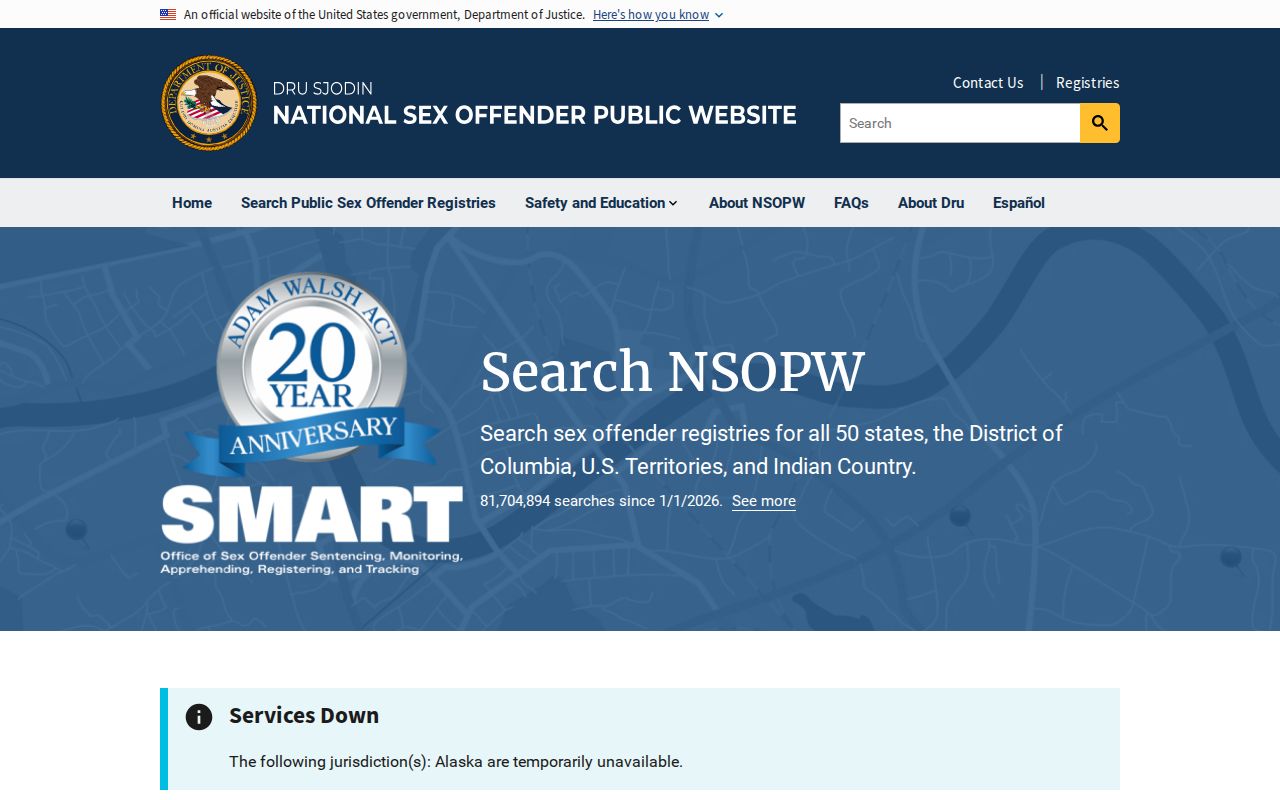
For a person tied only to Monroe County, the ISP profile remains the main record and the local registering agency remains the correction contact.
Lawful Use and Community Notification
Community awareness works best when the official profile is read in context. Check the update date, identity fields, address designation, and registering agency before acting on a result. If a child-safety plan is needed, focus on supervision, trusted contacts, and lawful reporting. The public registry cannot establish that an unlisted person presents no risk, and a compliant label cannot guarantee future behavior.
Registry information is meant for awareness and reasonable safety planning. It can inform a household’s choices about routes, supervision, and community conditions. It is not permission to approach a listed person, publish accusations beyond the official record, or target a household. ISP’s registry disclaimer also warns that data may change and should be verified with law enforcement.
Report a suspected failure to register to the police department or sheriff with jurisdiction. Give the agency the profile name, the observed issue, the place and time, and a way to contact you. Do not investigate at the residence. Law enforcement decides whether facts amount to noncompliance.
Use registry data lawfully: ISP warns that harassing, threatening, stalking, or intimidating a registrant or household can violate Illinois criminal law. Never use a listing to confront someone.