
How to Check Criminal History in Columbia
Use Columbia Police for CPD-created reports, Monroe County Jail for current custody, and the Circuit Clerk for filed charges and outcomes. ISP adds statewide conviction information or a fingerprint-based review of one’s own history. No official Columbia arrest log or separate city court portal was verified.
- Confirm Columbia Police was the agency involved.
- Send CPD a focused FOIA request for the incident or arrest report.
- Call the Monroe County Jail at 618-939-8651 for current custody.
- Search the Monroe Judici case system for filed charges and dispositions.
- Use ISP Access and Review for a fingerprint-based check and challenge of your own state record.
These layers can disagree for ordinary reasons. Police data may predate a charging decision, and a court outcome may take time to link to the state arrest cycle.
Columbia Police FOIA Officers
Columbia identifies Deputy Chief Josh Bayer and Records Clerk Jennifer Woodcock as police FOIA officers. Their named roles give a requester a clear city contact when a CPD report is needed. Completed requests may be emailed, delivered, or mailed to the Columbia Police Department.
Columbia Police Department
1020 N. Main St.
Columbia, IL 62236
618-281-5151
FOIA@columbiaillinois.com
Monroe Circuit Clerk
100 S. Main St., Room 115
Waterloo, IL 62298
618-939-8681
The official CPD FOIA page shown here identifies both officers and the correct records destination.
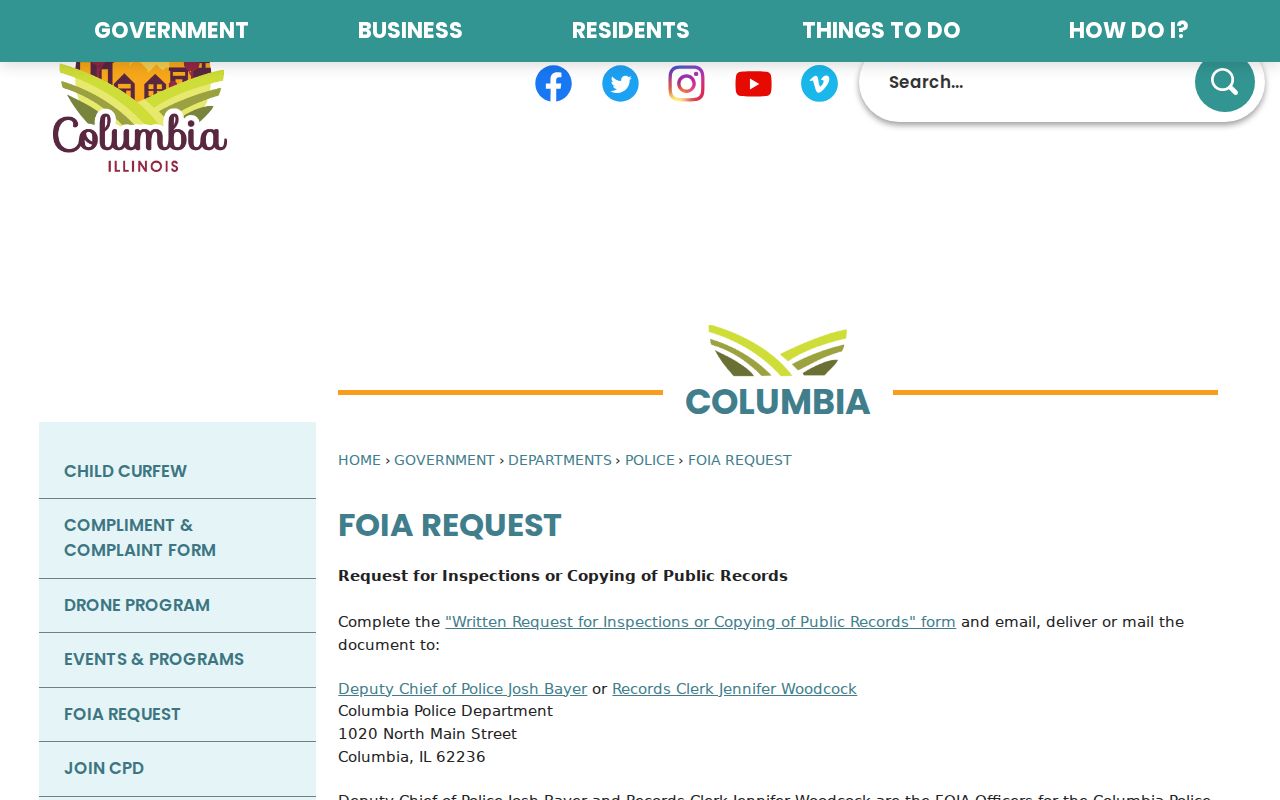
Addressing the request to CPD keeps the city police record with its actual custodian.
The Columbia Police Department
CPD holds reports made by its officers before the information reaches county custody or court systems. Its main number is 618-281-5151, fax is 618-281-6644, and the police records email is FOIA@columbiaillinois.com. A report request should name the incident date, location, involved person, report number if known, and the precise part requested.
The official department directory shown here confirms the police-building context and city contact channel.
The directory is useful for contact verification, while the dedicated FOIA page governs a public-record request.
Columbia Police Request Fields
The Columbia request form gathers enough detail to locate a city police file and return it through the chosen channel. Fill the date range and description narrowly. If a waiver is sought, explain the public-interest basis.
| Requester | Name, firm if any, mailing address, phone, fax, and email. |
|---|---|
| Date Range | Records sought from and to dates. |
| Description | Incident, location, people, and exact record component. |
| Purpose | Commercial-purpose checkbox and fee-waiver request with explanation. |
| Certification | Requester signature and date. |
| Office Tracking | Received date, due date, FOIA number, delivery, fees, denial reason, and response officer. |
The office block explains why CPD may refer to a FOIA number, delivery date, or clarification. Keep the submission and response together.
Five-Day Columbia Response Track
Columbia’s form states that an ordinary request generally receives a response within five business days. A lawful extension can add five days. Commercial-purpose requests follow a separate 21-day track. These periods are response rules, not promises that every requested page will be released without review.
CPD may produce records, deny with a stated basis, ask for clarification, notify the requester of an extension, or release a redacted copy. Illinois FOIA protects some victim, juvenile, medical, confidential-source, active-investigation, and security information. Ask for the nonexempt remainder when only part of a report is protected.
Email, Delivery, or Mail to CPD
Columbia offers three clear submission paths. Email to FOIA@columbiaillinois.com provides a timestamp and works well for the completed form and a short attachment. Hand delivery reaches the police building at 1020 N. Main Street. Mail is useful when a signed paper original or payment must travel with the request. Use the police address on the envelope, not the City Hall address.
Whichever path is used, request confirmation of receipt and retain a copy. The office-use part of the form includes a received date, due date, and FOIA number. Those fields let both sides track the statutory response period. If CPD calls to clarify the date range, location, or delivery choice, answer in writing when practical so the final scope remains clear.
Fax is listed as a requester contact field and the department publishes 618-281-6644, but the official research identifies email, delivery, and mail as the request-submission choices. Confirm with CPD before treating fax alone as the completed submission route.
Arrests and Bookings in Columbia
A Columbia arrest can yield two separate early records. CPD owns its arrest or incident narrative. Monroe County Jail owns the booking and custody file if the person is transported there. Neither record proves a conviction, and the booking allegation can differ from charges later filed by the Monroe County State’s Attorney.
No official CPD arrest blotter was verified. For recent activity, request the CPD report and call the jail. For a filed case, use Judici or the Circuit Clerk. The clerk’s criminal desk is extension 237, while traffic, ordinance, juvenile, and background-check routing uses extension 249.
Local sequence: Columbia Police › Monroe County Jail › 24th Judicial Circuit.
Columbia Juvenile Expungement Route
CPD navigation links juvenile-expungement information, a useful path for a person reviewing and clearing their own record. Juvenile access differs sharply from ordinary adult public access. Do not expect a public name search to expose a protected juvenile file.
Use the current Illinois Courts forms hub rather than an old saved PDF. Gather every arresting agency, date, case number, charge, and outcome first. The Monroe Circuit Clerk can help identify local case records, but cannot give legal advice.
Follow a Columbia Citation Into Judici
A Columbia citation can move from a city officer’s record into the county court system. Begin with the citation number, the cited person’s name, and the issue date. Search Judici’s Monroe County endpoint. Weekend daily-docket views may advance to the next court date, so use the case search instead of assuming a quiet daily list means no file exists.
Judici can present a humanity check before its case fields. If the gate does not work, call the Circuit Clerk at 618-939-8681. Extension 249 routes traffic and ordinance questions. Ask whether the citation has been filed, request the case number, and confirm the next date. A city citation is an allegation. The docket and final disposition show what happened after filing.
Electronic access does not guarantee that every document image is online. The courthouse public terminal and clerk counter can help with records that are archived, not scanned, or otherwise absent from the public view. Certified copies must come from the custodian, not a screenshot of the vendor page.
Columbia Municipal Court Records
There is no separate Columbia municipal court in the current Illinois system. City ordinance and traffic cases are heard through Circuit Court. This is why CPD’s report channel and the county court channel must both be checked.
| Court | Monroe County branch of the 24th Judicial Circuit. |
|---|---|
| Columbia Matters | Ordinance, quasi-criminal, traffic, DUI, misdemeanor, and felony cases when filed. |
| Lookup | Monroe Judici endpoint, clerk counter, or courthouse public terminal. |
| Docket | Case type, charges, hearings, entries, disposition, sentence, and public financial data. |
| Copies | Order through the Circuit Clerk and request a current fee quote. |
OV identifies ordinance cases, QC quasi-criminal, TR minor traffic, MT major traffic, DT DUI, CM misdemeanor, and CF felony. A code identifies a case track, not guilt.
Columbia City Hall Is Not CPD
Columbia City Hall is at 208 S. Rapp Avenue, with general weekday hours from 8 a.m. to 4:30 p.m. Its main number is 618-281-7144. Police-record requests instead go to CPD at 1020 N. Main Street. That address split is the most common routing trap in Columbia.
Email gives a time-stamped path to FOIA@columbiaillinois.com. Delivery and mail remain valid choices. If fax is used, retain the transmission report and confirm receipt through the police main line.
CPD Report Versus Sheriff Booking
The CPD report explains what Columbia officers documented and what action they took. The Monroe County booking file records intake, custody, property, and release activity at the jail. They are linked by an event but are not duplicates. A person may have a police report without county booking, or a county booking record whose arrest narrative remains with CPD.
For a recent case, compare the arresting agency, intake date, and eventual court number. Do not infer a conviction from either early record. The State’s Attorney may file different charges, decline charges, or file no case. When a case is filed, each count can end differently. A dismissal on one count does not state the result of every other count.
Where Columbia Records End Up
CPD remains custodian of the original police narrative even after a person is booked by the county. If charges are approved, the Circuit Clerk opens the court case and records hearings and outcomes. Qualifying arrest fingerprints and final dispositions are reported to the Illinois State Police Bureau of Identification.
Record flow: Columbia Police › Monroe County Courts › Illinois State Police Bureau of Identification.
For the newest event, start locally. For a resolved Columbia case, read each court count’s disposition. For statewide public conviction data, consult ISP’s UCIA information. CHIRP is authenticated and agreement-based, not an anonymous public people search.
Columbia and Waterloo Nearly Match
The official 2020 count placed Columbia at 10,999 residents and Waterloo at 11,013, a gap of just 14. That near tie helps explain why both cities have distinct police-record systems even though county booking and court stages converge in Waterloo.
Population does not prove anything about crime or a person. It only supplies local context. The key practical difference is custodianship: a CPD-created report stays with Columbia, while the county jail and Circuit Clerk keep their own later records.
Public Access Rules
Accuracy depends on reading the full chain. CPD may record an arrest allegation, the jail may record a brief custody period, and the court may later show no filed case, a dismissal, supervision, an acquittal, or a conviction. “Arrested,” “booked,” and “charged” are not synonyms for “convicted.” A court case can also mix outcomes across several counts.
If the state conviction response differs from the Columbia court file, verify the disposition with the Circuit Clerk and use ISP’s own-record review and challenge process. Name matching can join or miss similar identities. A fingerprint-based self-review offers stronger identity assurance. Include the arresting agency, arrest date, case number, charge, and final outcome when reporting a possible mismatch.
The Illinois Freedom of Information Act governs CPD executive-branch records. Court files use judicial access rules. Sealed, expunged, impounded, juvenile, and other protected records do not become public merely because a search tool exists.
Key Statutes:
5 ILCS 140 sets Columbia’s ordinary FOIA response, exemption, review, and reproduction framework.
20 ILCS 2635 controls public state conviction information and misuse rules.
Illinois court access policy limits electronic display and protects restricted files.
A denial should identify its legal ground and review route. Request the releasable remainder rather than treating one redaction as a denial of the whole Columbia report.