
How to Check Criminal History in Monroe County
No single Monroe County database is a full criminal history. Begin with the exact Monroe County Judici search for filed cases. It can lead to pending charges, case events, outcomes, sentences, and financial entries. A court result does not replace the arrest report or jail record. Likewise, an Illinois State Police conviction response does not show every arrest or every local docket event.
Gather the full name, likely spelling variants, approximate dates, and the court or arresting agency before searching. Use a date of birth only when it is lawfully visible and necessary to distinguish people. Then follow the record through its proper custodians.
- Search the Monroe Judici endpoint and note the case number and type code.
- Call the Circuit Clerk when the online file is missing, archived, or unclear.
- Ask the arresting police agency for its incident or arrest report.
- Call Monroe County Jail for current custody or a recent booking event.
- Use ISP channels for statewide conviction information or review of your own fuller record.
Read each count to its disposition. Arrest, charge, conviction, and custody are separate facts. A common-name match without the same case number, dates, and agency is not enough.
Monroe Court Record Search Fallback
Judici showed a humanity check during research, so online access may stop before the search form or case detail. The dependable fallback is the Monroe County Circuit Clerk in Room 115 at 100 S. Main Street, Waterloo. The main number is 618-939-8681. The criminal desk is extension 237, while the background-check, traffic, ordinance, and juvenile desk is extension 249. The public counter is open weekdays from 8:00 a.m. to 4:30 p.m.
Ask for archived or nonelectronic files, certified copies, and a current fee quote. A law-library public terminal is available for court research and e-filing. Payments and copy charges may go through Judici, CourtMoney, mail, the counter, or the shared Market Street circle-drive drop box. Mark the envelope “Circuit Clerk” because several courthouse offices use that box.
The official Circuit Clerk page shows the docket and clerk routes used for Monroe County case access.
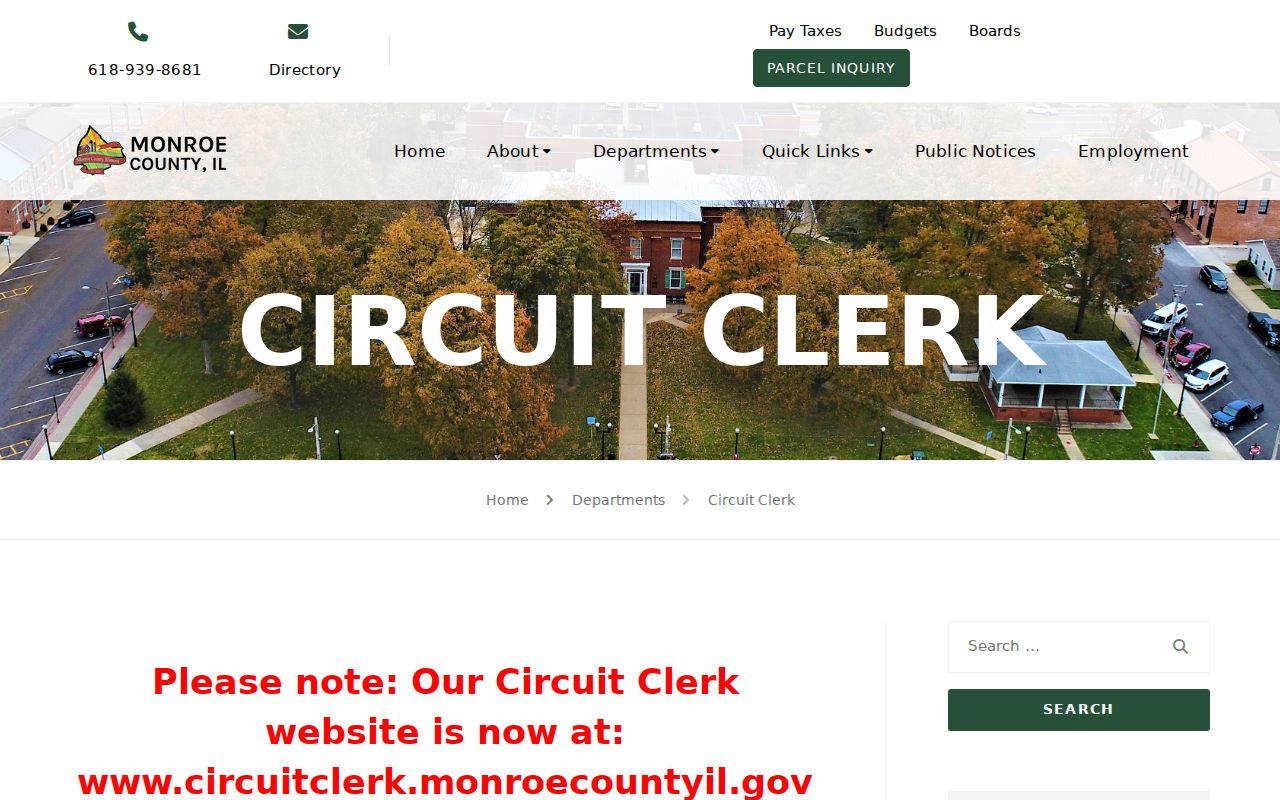
The captured page reinforces that the clerk, rather than a general county FOIA office, is the source for the judicial file.
Official Illinois Background Checks
The Illinois State Police Bureau of Identification keeps the state criminal-history repository. Under the Uniform Conviction Information Act, its public product is reported conviction information. It is narrower than a person’s complete fingerprint-based transcript. CHIRP is not an anonymous public people search. Its login requires an Illinois Digital ID or Entrust credential and eligibility under an ISP user agreement.
Name-based UCIA inquiries cost $10 electronically or $16 on paper. A fingerprint UCIA inquiry costs $15 electronically or $20 by paper card, with a $10 resubmission. A live-scan provider may charge a separate capture fee. Illinois fingerprints taken in the state must be sent electronically through an IDFPR-licensed live-scan vendor. No verified vendor street location inside Monroe County appeared in the reviewed official vendor extracts, so use the current state list rather than an assumed local address.
| ISP request | Paper | Electronic |
|---|---|---|
| UCIA name inquiry | $16 | $10 |
| UCIA fingerprint inquiry | $20 | $15 |
| State plus FBI applicant check | $32 | $27 |
| FBI only | $12 | $12 |
The official ISP fee schedule is the source to check before paying for a state inquiry.
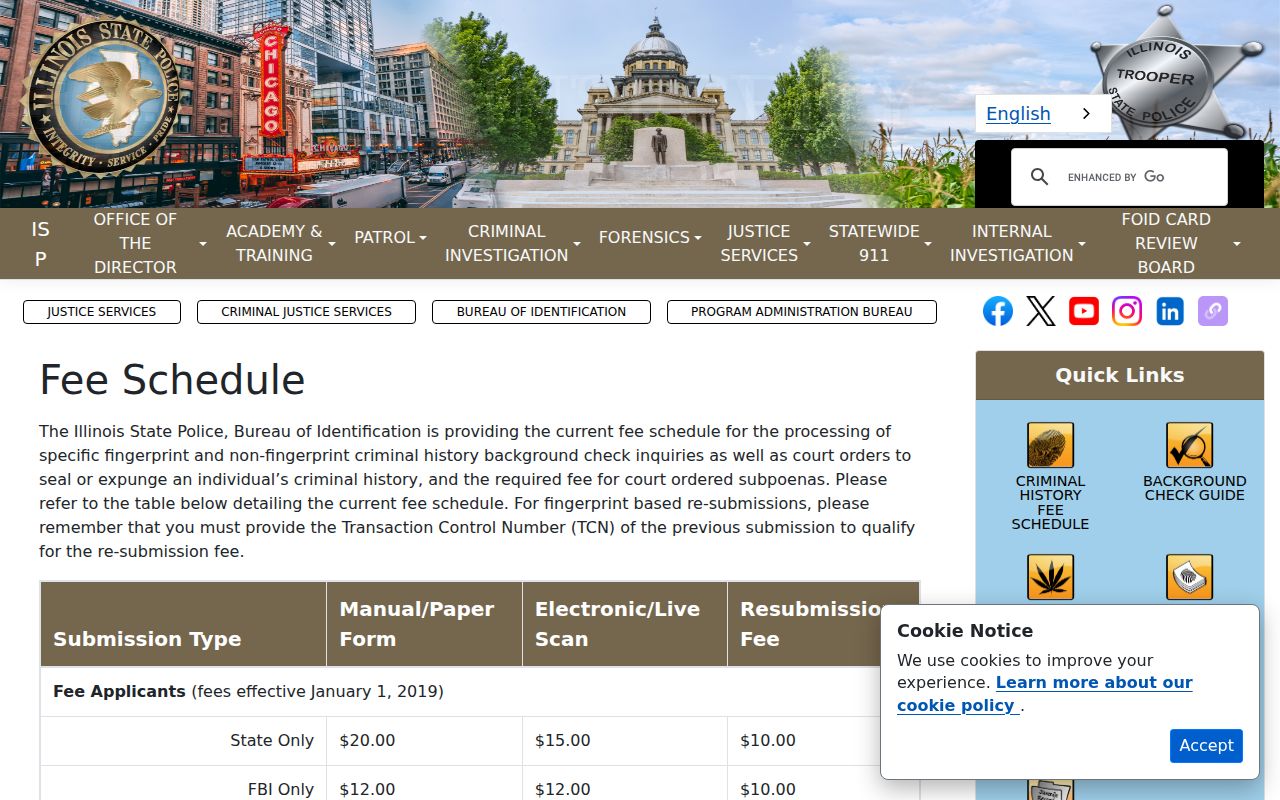
The published schedule separates repository charges from any fee a live-scan vendor may add for capturing fingerprints.
For your own record and a correction route, use ISP Access and Review. Fingerprints and identifying data go to ISP, which mails a transcript and challenge form or a no-record letter. ISP does not charge for its review or challenge, though the fingerprint site may charge for capture.
Monroe CHIRP and Fingerprint Records
Name matching can join the wrong person or miss a spelling variation. Illinois law distinguishes information based on positive fingerprint identification from a result based on other identifiers. Reporting lag, an old paper case, or a disposition that failed to link back to an arrest cycle can also create a mismatch. That is why a Monroe County court file and a UCIA response should be compared rather than treated as duplicates.
The ISP criminal-history page explains the conviction-information product and its limits.
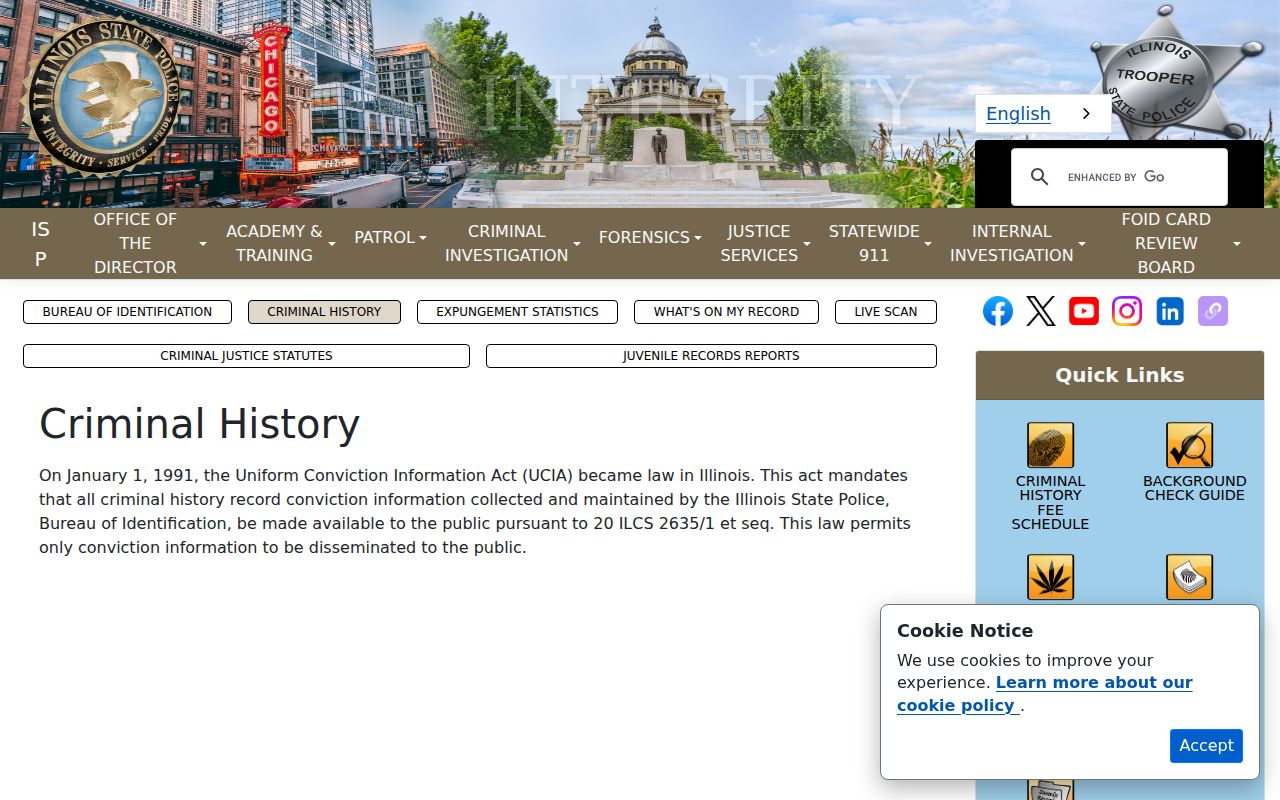
This state source is the right starting point for the official product, while the Monroe Circuit Clerk remains the source for the local case file.
The ISP Access and Review instructions cover the stronger identity-based route for checking and challenging your own state record.
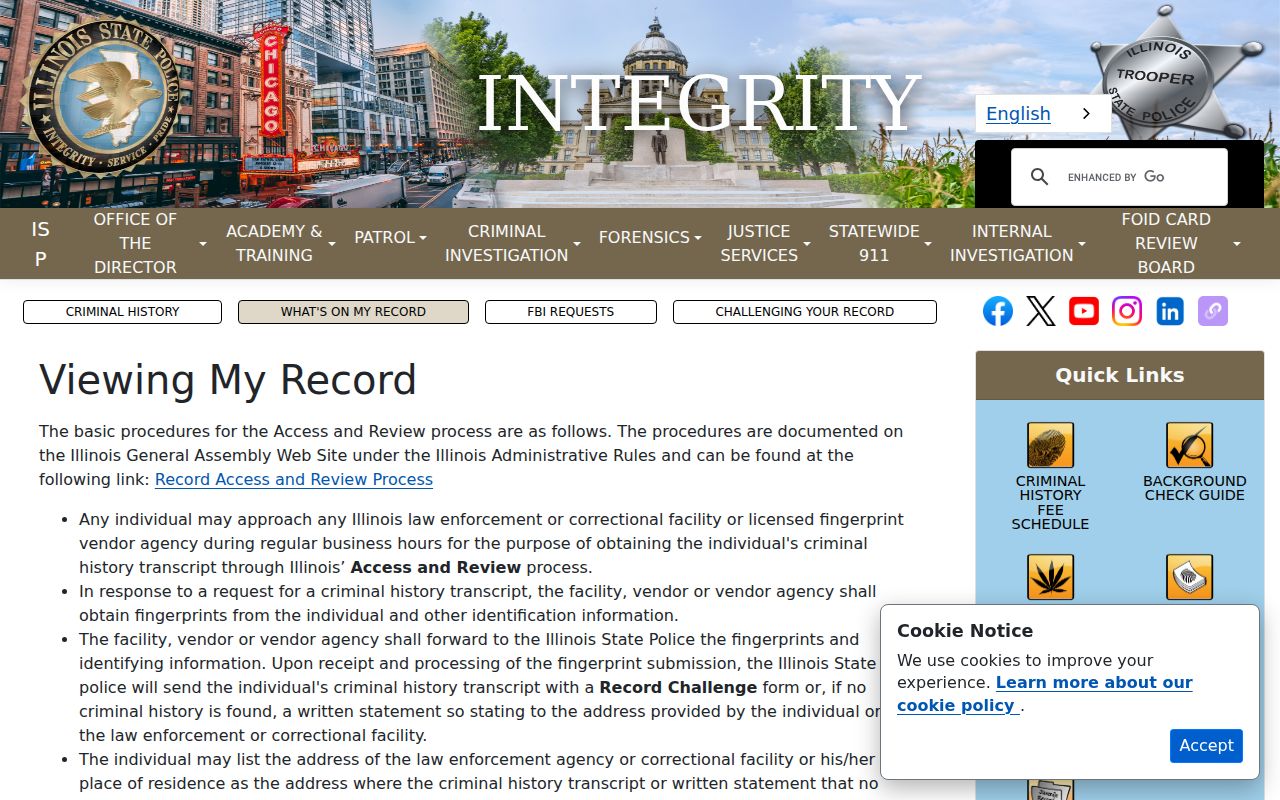
That process supplies a correction path that an ordinary name inquiry does not.
Types of Criminal Records
Monroe County agencies create a chain of records rather than one master file. The arresting agency writes the incident and arrest report. If the person enters the county jail, the jail makes intake, custody, property, screening, and release records. The State’s Attorney decides what charges to file, and the Circuit Clerk keeps the resulting case. ISP receives qualifying fingerprints and later disposition data.
- Booking record
- Jail intake and custody data tied to allegations at that time, not a finding of guilt.
- Court case
- The complaint, docket, hearings, motions, disposition, sentence, and financial entries kept by the clerk.
- UCIA response
- Statewide reported conviction information that ISP may release to the public.
- Access and Review
- A fingerprint-based copy of one’s own fuller ISP history with a formal challenge route.
- Registry record
- Public information required by a qualifying registration law, not a complete criminal history.
Warrants, probation supervision, IDOC custody, and federal custody add still more layers. A negative search in one layer does not erase a record held by another custodian.
Monroe Jail Booking Record Gap
No verified official browser roster or booking log was found for Monroe County Jail. Do not substitute an unofficial inmate site. Call the jail at 618-939-8651 for current custody, request an existing booking record through sheriff or county FOIA, and review official sheriff app information. If a sentenced person has transferred to state custody, use the IDOC Individual in Custody Search. VINELink may provide notifications where available.
The jail at 225 E. Third Street in Waterloo was built in 1986 and has a rated capacity of 42. An IDOC 2024 inspection recorded 34 people on its inspection day, which is only a one-day snapshot. It also documented off-site scanned mail, a padded safety cell, a transport van, and three body cameras. Of 2,175 expected 30-minute observation checks, 2,057 were timely, or 95 percent.
Current custody proves neither the final charge nor a conviction. For the underlying case outcome, move from the jail response to the clerk’s docket and read each count.
What a Monroe County Criminal Record Shows
The fields depend on the custodian. A Monroe court file can show the case number and code, parties, filing date, charges, hearings, docket events, outcome, sentence, and financial obligations. A booking file instead centers on intake, arresting agency, allegations, property, custody, and release. ISP’s public response centers on reported convictions.
| Name and identifiers | Names and lawful identifiers used to match the record to the correct person. |
|---|---|
| Arrest or booking | Agency, date, intake, allegations, and custody or release status where releasable. |
| Charges | Counts filed in court, which may differ from the arresting officer’s allegations. |
| Disposition | The outcome of each count, such as conviction, dismissal, acquittal, or nolle prosequi. |
| Sentence | Custody, probation, restitution, and other court-ordered terms when public. |
| Supervision status | Local probation, IDOC custody, or mandatory supervised release in the relevant system. |
Illinois court supervision that is completed successfully is not a conviction, though a public record may remain until lawfully cleared. One case can also contain both dismissed and convicted counts. Read the result count by count.
Monroe Criminal Case Codes
The local code helps identify the docket before a clerk call. CF means criminal felony, CM criminal misdemeanor, DV domestic violence, MX miscellaneous criminal, and DT DUI. TR is minor traffic, MT major traffic, OV ordinance violation, CV conservation violation, and QC quasi criminal. Juvenile matters use separate codes and access limits.
A code identifies the case category, not the result. CF does not mean every count led to a felony conviction. OV or traffic files are heard in the unified circuit system, not in separate Waterloo, Columbia, or Valmeyer municipal courts. Use the code to reach the correct desk, then inspect the disposition.
Note: “Pending” means unresolved, “disposed” means resolved, and “vacated” means a prior judgment or order was set aside.
Public Access Laws
Illinois uses different access rules for executive-agency records, court files, and state criminal-history data. A Monroe County FOIA request asks for an existing agency document. It does not require an office to answer a question or create a new report. Court dockets go through the Circuit Clerk and judiciary rules instead of ordinary county FOIA.
Key Illinois laws:
5 ILCS 140/3 sets the five-working-day response framework for ordinary noncommercial FOIA requests.
5 ILCS 140/6 governs copy charges, including the ordinary first 50 black-and-white pages without charge.
20 ILCS 2635/5 governs public access to ISP conviction information.
20 ILCS 2630/5.2 governs qualifying expungement and sealing relief.
Active investigative facts, juvenile material, victim and witness information, medical facts, protected identifiers, and security details may be withheld or redacted. A denial should state its legal basis and review route. Ask for the nonexempt remainder when part of a record can be released.
Monroe County FOIA Record Route
For sheriff or county administrative records, identify the exact existing item: incident narrative, arrest report, booking sheet, CAD log, 911 audio, or photograph. Include the agency, approximate time and place, incident number if known, and the desired component. City police reports stay with the city that created them even if Monroe County Jail handled the booking.
Requests may go in person, by mail, or by email to Sausha Alderman, Monroe County FOIA Officer, 100 S. Main Street, Waterloo, IL 62298. The phone is 618-939-8681 extension 232 and the email is foia@monroecountyil.gov. Ordinary noncommercial requests have a five-working-day response framework, subject to a written statutory extension.
The Monroe County FOIA page lists the official submission channels and copy rules.
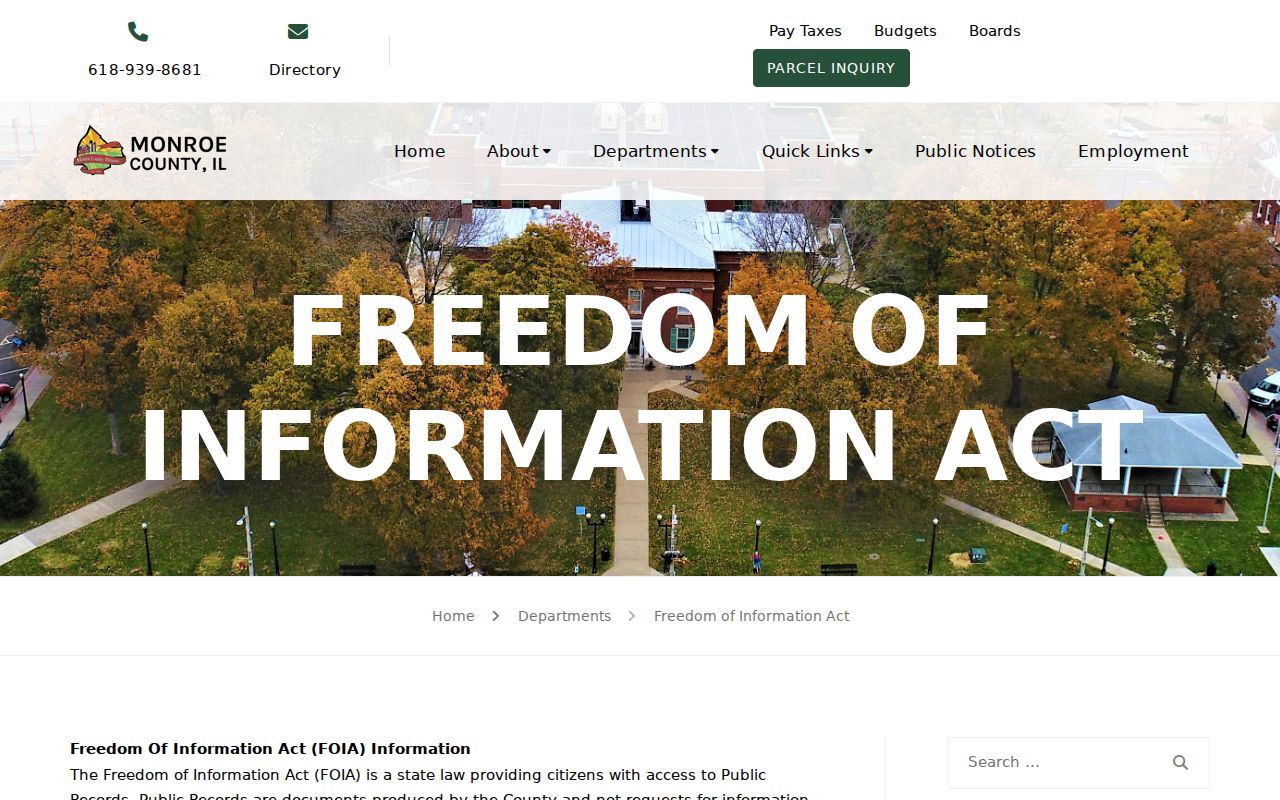
The first 50 ordinary black-and-white letter or legal pages are free, then additional pages cost $0.15 each; color and oversized copies use actual reproduction cost.
Sealed, Expunged & Restricted
Sealing and expungement are not the same. Expungement generally destroys or returns records and removes the public index as Illinois law directs. Sealing blocks ordinary public access while courts, police, prosecutors, IDOC, and other authorized bodies retain access allowed by law. Juvenile records follow separate rules, and sealed, expunged, impounded, or protected files do not appear in ordinary electronic court access.
File in each circuit clerk jurisdiction where the arrest or charge occurred. The current Illinois Courts forms include the request, case list, added-case pages, orders, and certificate of service. A petition must identify each matter, and relief is not automatic. Monroe County’s accessible older schedule listed a $60 clerk filing charge plus ISP’s $60 processing fee per granted case, but current amounts should be confirmed with the clerk.
Future automatic-sealing phases begin in 2028 and later, with staged compliance toward 2034. Those enacted phases are not current relief. Use the present statute and current statewide forms for a filing now.
Monroe Warrant and Custody Records
No verified official Monroe County warrant-search page was located. Call the sheriff at 618-939-8651 for safe instructions, and do not walk into a records counter on the assumption that a warrant can be resolved there. Search the related Judici docket and call the Circuit Clerk for case status. A city citation or ordinance matter may also require the originating police department.
For prison custody after sentencing, the Illinois Department of Corrections Individual in Custody Search is the state layer. Federal cases are heard in the Southern District of Illinois, with the courthouse at 750 Missouri Avenue in East St. Louis, and federal dockets use PACER. The BOP locator covers federal custody only. None of those tools substitutes for Monroe County Jail’s current-custody response.
Criminal Records by City in Monroe County
Waterloo, Columbia, and Valmeyer each create local police or village records, while filed charges move to Monroe County Circuit Court. Waterloo police records go to the police department rather than City Hall. Columbia names its own police FOIA officers. Valmeyer uses a village FOIA packet and has no verified online police portal. These local routes matter because a jail booking does not transfer ownership of the arresting agency’s report.
Waterloo Criminal History
2020 population 11,013. Police records begin at 301 S. Main Street.
Columbia Criminal History
2020 population 10,999. CPD accepts FOIA requests by email, delivery, or mail.
Valmeyer Criminal History
2020 population 1,233. Village FOIA offers the documented local records route.
Once a charge is filed, all three communities use the Monroe branch of the 24th Judicial Circuit. Illinois has not kept separate municipal courts since the unified judiciary began in 1964.
Monroe County Record Offices
Choosing the custodian saves time. The clerk supplies the prosecution file. The sheriff and jail handle sheriff-created reports and custody records. ISP supplies public conviction information and a separate personal review process. The arresting city agency keeps its own narrative.
Monroe Circuit Clerk
Room 115, 100 S. Main St.
Waterloo, IL 62298
618-939-8681 ext. 224
Weekdays 8:00 a.m. to 4:30 p.m.
Monroe Sheriff and Jail
225 E. Third St.
Waterloo, IL 62298
618-939-8651
Call for current custody and record routing.
ISP Bureau of Identification
260 N. Chicago St.
Joliet, IL
815-740-5160
Restricted facility; appointments required.
A phone call can identify the right office, but a clear written request creates the formal FOIA track for an executive-agency record. Certified court documents still come from the clerk.